Semantic SEO & Build Topical Authority: A Beginner's Guide
Google does more than match keywords now. It tries to grasp what a page is about. If you only chase exact search terms and do not show real know-how, you can get pushed down.
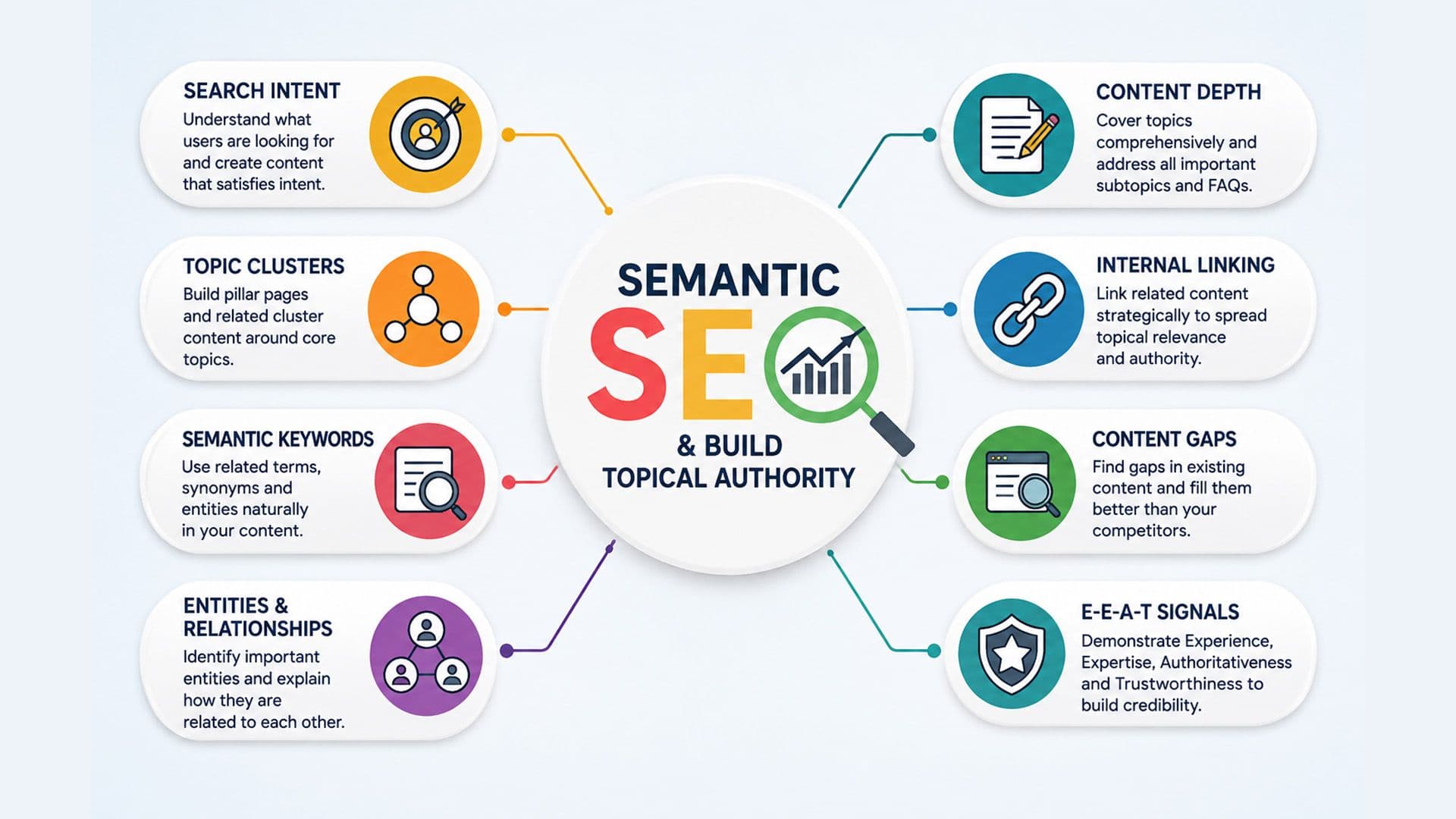
Some competitors are using semantic SEO. They link ideas in a clearer way and build a stronger topic focus. That helps them show up more often.
Here is a beginner's guide to semantic SEO & building topical authority. It explains the basics and why it matters for topical authority. You will also get hands-on tips for shaping a content plan that fits together. The guide covers how to do better in a standard search tool. It also looks at how you may earn more mentions in AI overviews.
Key Takeaways
- Semantic SEO goes beyond exact match keywords.
- Authority grows through site-wide topic coverage.
- Pillar and cluster pages establish subject depth.
- Internal linking helps connect related information.
- Strong authority improves your chances in AI search.
- Weak or outdated content can hurt topical strength.
What is Semantic SEO?
Semantic SEO is not only about one keyword. It is about writing so the topic makes sense. Instead of chasing one exact phrase, you cover the subject and the related ideas.
Search engines can then make better sense of the page. They look at the key entities and how the ideas connect. They also consider what a person is really trying to learn.
The intent is to answer the question well, not to repeat the same words nonstop. If you cover the topic in a clear way, later ranking updates usually have an easier time understanding your page.
How Does Semantic SEO Work?
Semantic SEO is mostly about linking your page to the right ideas and their connections. Instead of chasing one keyword, you match what you write to the entities in a topic.
Search engines also read more naturally. They try to figure out the meaning using language tools and structured knowledge.
When your content explains a topic in a clear and linked way, people usually find it more helpful. This often plays into better search results too. The page can also seem more trustworthy.
Why Semantic SEO Matters for Modern Searches
Search is not only about spotting the same words. It is more about the point the user is trying to make. New Google systems, like BERT and MUM, support this. They check if a page truly helps with what the question is asking. That is the main shift.
Overusing keywords can weaken your SEO performance. Pages that cover a topic naturally tend to perform better. It adds context and backs up the main idea. Trying to win with just one or two terms often falls short today.
What is Topical Authority in SEO?
Topical authority is about whether a website looks dependable for a specific subject. Usually, that trust builds over time as the site keeps writing about the core parts of the topic.
It also matters to address questions people ask a lot and to use the important related wording that fits the subject. A big part of the work is to cover the topic on lots of different pages. It is not just about running after one term.
Explore a topic thoroughly instead of leaving unanswered areas. Keep building comprehensive content to strengthen how search engines assess its usefulness.
How Does Semantic SEO Help Build Topical Authority?
This is where semantic SEO & build topical authority come together. Semantic SEO gives structure to topical authority. Organize content around entities, search intent, and relationships, not scattered keywords. This creates a connected body of content around your topic.
It helps search engines understand your website as a complete knowledge network. This connected content depth demonstrates authority far better than a collection of isolated, keyword-focused pages.
What are the key elements of semantic SEO?
The foundation of semantic SEO consists of several connected elements that work as a whole. Here’s what each building block focuses on.
Search Intent
You should match what the reader is trying to find. That can be learning something, looking for a site, comparing options, or buying. If you guess wrong, the page may not show up in results, even if it reads well.
Entities and Entity Relationships
Search engines also use entities. Entities can be people, places, ideas, or products. They link these items in the knowledge graph.
When you map how key entities connect in your space, you help signal the kind of topic depth that search systems look for.
Semantic Keywords and Related Terms
Use terms that sit close to your main topic. Think of them as other ways people describe the same idea. When writing sounds like real knowledge, these words show up on their own. You do not have to stuff them in just to chase rankings.
Topic Clusters
A topic cluster connects one main page with smaller pages. Each small page covers a sub-idea. All of them link to each other.
This way, search systems can see you covered the subject in more than one way. It is not only one narrow phrase.
Internal Linking
Good internal links tie similar pages together. They also help share value from one page to another. Search engines can use those links to see what belongs with what.
When important pages lack strong links, they can become disconnected and lose ranking potential.
Structured Data
Schema markup labels your content in a format search engines and AI systems can parse directly. It clarifies entities and page types, boosting your odds of appearing in AI-generated answers.
How to Build Topical Authority With Semantic SEO?
Topical authority is built through a planned process, not guesswork. This is the core of semantic SEO & build topical authority. Follow these steps to build it effectively.
1. Define Your Core Topic and Main Entity
Pick the main thing you want people to remember you for. Decide what the core is in that topic. It may be your brand, your product, or what you do best. Treat this as the main point. Everything else you share should point back to it.
2. Research Related Topics and Entities
Look into the topic and the things around it. List the subtopics, the questions people ask, and the related entities that fit.
Use common tools, look at what other sites already cover, and check real search phrases. This helps you see what full coverage usually includes.
3. Map Content to Search Intent
After that, organize what you found by search intent. Sort it into informational items, commercial items, or transactional items. Make sure each page or post has a job to do.
Also make sure it matches what the searcher likely wants. If a piece does not fit the intent, it often does not perform well in results.
4. Create a Comprehensive Topical Map
Create a simple topic map first. Start with the main topic. Then list the smaller sections under it. Add the key-related items too.
After that, note how each part connects to the rest. Use the map as your writing guide. This helps you avoid missing anything important.
5. Build Pillar and Cluster Content
Make a main pillar page first. Pick the core topic and cover it at a broad level. Then write cluster pages that zoom in on key subtopics.
Link the cluster pages back to the pillar page. Search engines can then follow the trail and understand how everything fits together.
6. Cover Topics With Depth and Relevance
Go deeper than the surface. Do not stop at simple definitions. Include nuance, common edge cases, and the kinds of questions a specialist would ask. Make every section concise and to the point.
Still, make sure you cover what matters, not just the basics. Strong depth is what helps the page feel truly reliable, not like it only mentions the subject.
7. Connect Related Pages With Internal Links
Link the related pages to each other with internal links. Use clear anchor text that shows how the pages connect. This helps people follow the topic and helps search engines understand how your site is organized.
8. Optimize Content for Semantic Relevance
Revise the content to fit the topic better. Include nearby terms, named entities, and supporting ideas in a way that sounds normal in context.
Do not loop the same main keyword again and again. Write with real depth, so it feels helpful, not like it was built just for rankings.
9. Identify and Fill Content Gaps
Check for what you left out. Look at your topic map and compare it to what other sites say. Also read what people seem to ask for.
You may find spots you did not cover. Add those pieces so others cannot act like they did everything first.
10. Update and Expand Your Content Regularly
Refresh your content consistently to keep it useful and relevant. Review older posts and update them with new details when needed. Also bring in related points that you did not cover before.
Make sure the page still matches what people are trying to find now. That helps your group of pages stay relevant and believable.
How Does Semantic SEO Support AI Search and AI Overviews?
AI overviews and answer engines synthesize responses from trusted sources. They favor structured, comprehensive expertise over isolated keyword matches.
Semantic SEO changes the goal. It pays more attention to what a visitor is trying to get. It also ties a subject to real things in the world and shows how related ideas connect. Strong topical authority makes citation in generative results far more likely.
Common Semantic SEO Mistakes to Avoid
Even solid content strategies fall apart when a few basic mistakes creep in. Here's where most sites lose ground without realizing it.
- Chasing exact match keywords instead of covering real meaning.
- Publishing single articles with no cluster or pillar support.
- Overlooking the searcher’s actual goal or intent.
- Skipping internal links between related pages.
- Leaving out schema markup entirely.
- Letting old content sit untouched for years.
- Treating topical authority as a one-time task, not an ongoing effort.
- Writing for search engines instead of real readers.
- Duplicating coverage across pages instead of going deeper.
- Ignoring entity relationships within the niche.
How to Measure Your Topical Authority?
Topical authority isn't measured by one ranking or traffic number. Look at how strongly your website performs across an entire subject area.
- Check whether multiple pages rank for different searches around the same topic.
- Monitor your visibility for related keywords, questions, and subtopics.
- Compare organic traffic growth across your connected content.
- Review whether visitors engage with your content instead of leaving quickly.
- Check if your pages are properly connected through relevant internal links.
- Track your visibility in AI-generated answers and search features.
- Look for stronger rankings across broader topic areas over time.
- Identify content gaps where competitors are gaining visibility.
Semantic SEO and Topical Authority: A Practical Example
A local bakery initially published separate posts around “birthday cake ideas.” It then created a pillar page focused on cake design and supported it with cluster content covering flavors, dietary options, and occasion-specific guides.
This connected strategy helped build deeper topical coverage around cake design. Within weeks, they ranked for dozens of related searches and started appearing in AI-generated recipe and gift suggestions.
Conclusion
Semantic SEO & building topical authority are not two separate plans. They support each other for stable results in 2026. When you do both, search engines can read your pages in context. Over time, that makes your site feel more reliable.
Begin with one main theme. Cover it in a clear, complete way. Then add related sections step by step, not all at once. Keep improving and keep publishing so the site earns strength slowly.

Usama Shareef
Usama Shareef is the COO of Mahraj Technologies, bringing strong expertise in SEO content writing, software QA, and development testing. He specializes in delivering high-quality digital solutions with a focus on performance, accuracy, and scalable growth