Local SEO for Real Estate Companies: A Complete Guide
Homebuyers and sellers often begin their search on Google with queries such as “real estate agent near me” or “homes for sale in Islamabad.”
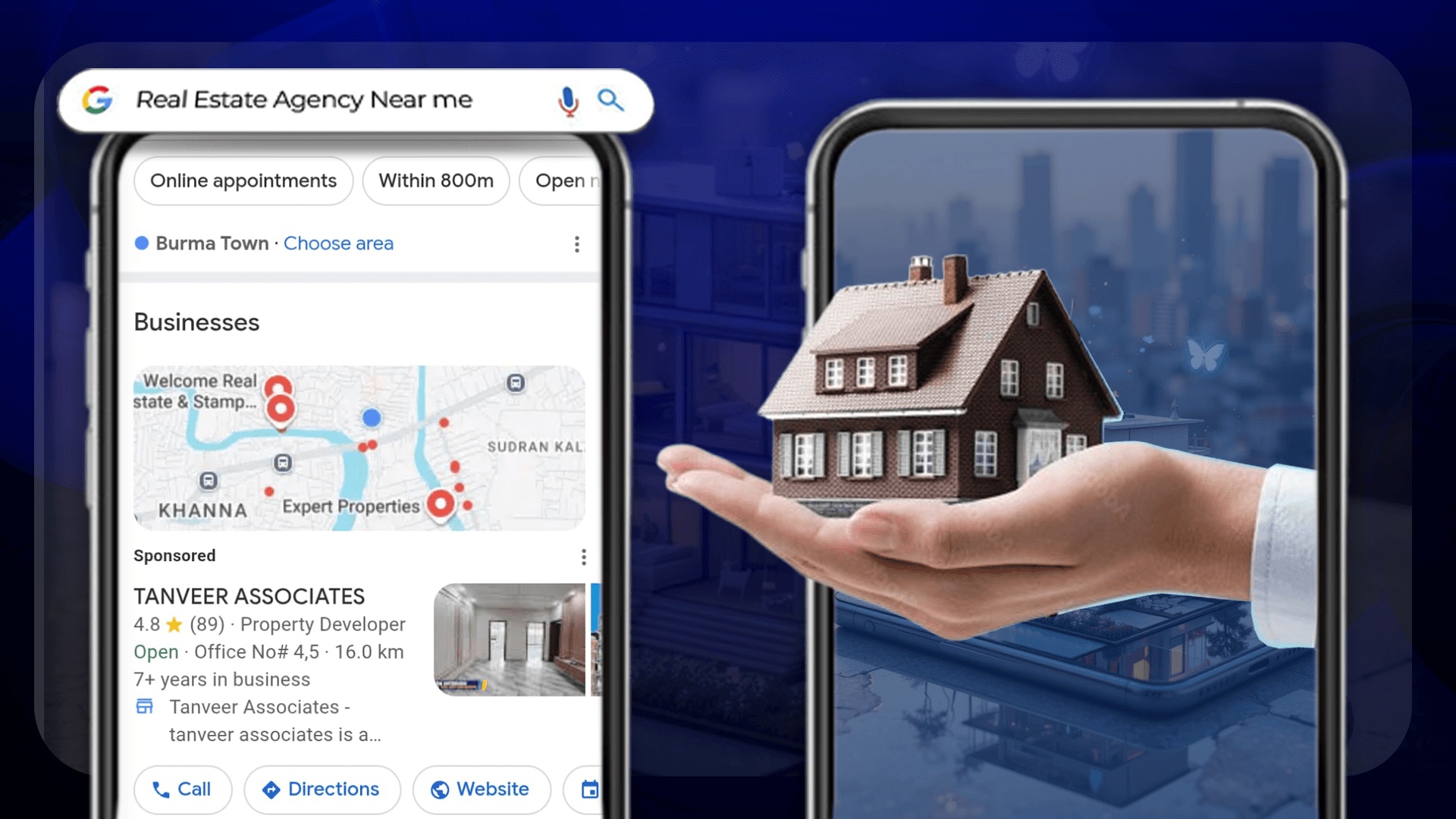
Local SEO helps real estate companies appear when potential clients search for properties and real estate services in their target areas. It can improve visibility across Google Search and Maps while helping businesses attract more relevant local traffic and leads.
This guide talks about how real estate businesses can put together a steady local presence online. It goes over Google Business Profile basics to AI driven search too, so it covers the essentials, more or less.
Key Takeaways
- Local SEO is built around relevance, distance, and prominence.
- GBP, reviews, and consistent NAP are high-impact local SEO factors.
- Localized neighborhood pages can outperform broad city pages.
- Each brokerage location needs its own local SEO strategy.
- AI overviews are reshaping search, as organized content helps, but schema alone cannot guarantee visibility
What Is Local SEO for Real Estate Companies?
Local SEO helps real estate companies show up for place-based searches, like cities, neighborhoods, and those “near me” kind of queries.
Instead of chasing broad, national keywords, it tends to lean into nearby attention and local visibility, so people in the right area actually find them.
How It Differs from Traditional SEO
Traditional SEO leans on content and backlinks, mostly. While local SEO just adds this geography-based layer, like it’s not optional. It uses GBP signals, citations, searcher proximity, and localized content to improve local visibility.
Understanding Local Search Intent
"Near me" and location qualified searches signal high intent, like the searcher usually wants to act soon.
Google uses device location to show hyper local results. Sites targeting only broad terms like “buy a house” can lose visibility to competitors targeting specific service areas.
Why Local SEO Matters for Real Estate Companies
Local SEO helps real estate companies appear when buyers, sellers, and renters search online. It connects them with relevant listings and realty services in specific neighborhoods. It ramps up discoverability on Google Search and Maps.
It also helps create local credibility and brings in genuinely interested people. With a solid local SEO approach, you might get more calls, more property questions, more viewing requests, and better quality leads, all from the exact areas you care about.
Google's Local Ranking Factors
Google states that local results are mainly based on relevance, distance, and prominence.
- Relevance measures how well your business profile matches the search.
- Distance considers how far your business is from the searcher or location specified in the query.
- Prominence reflects how well-known a business is, with signals including links and reviews contributing to Google's understanding of prominence.
The Local Pack vs. Organic Local Results
The Local Pack is the map-based block of three listings pulled primarily from GBP data. Organic local results are the standard listings below it, driven by on-page and off-page SEO.
It’s worth optimizing for both, because they pull in different audiences, different slices of visitors in the real world.
Key Local Ranking Signals
Important areas to manage include:
- Google Business Profile information
- Reviews and review responses
- Website relevance
- Local business information across the web
- Links and other prominence signals
- Location-specific content
Google also gathers business information from websites, third parties, users, and other sources.
Local SEO Audit: Where to Start
Before implementing a new strategy, audit your current local presence.
Reviewing Site Structure and On-Page Elements
Go back and review your titles, headings, URLS, and the internal links too. Then also check your location pages, your property pages, the contact details, and the whole site structure.
Ensure that the important local pages are easy for real people to find and also for search engines to discover, without any weird extra steps or confusion.
Free Tools to Use
Useful starting tools include:
- Google Search Console
- Google Analytics
- Google Business Profile Performance
- PageSpeed Insights
Use them to identify search visibility, traffic, technical issues, and user behavior.
Local Keyword Research for Real Estate Companies
Keyword research reveals what potential buyers, sellers, landlords, and renters search for. It helps you identify relevant searches in your target locations.
Understanding Search Intent
Separate keywords according to the user's goal. A person searching “how to sell a house” needs different content from someone searching “real estate agent in Islamabad.”
Commercial and transactional terms should have clear paths toward inquiries or consultations.
Finding Long-Tail and Neighborhood-Specific Keywords
Broad terms like "real estate agent" are dominated by portals. Long tail, neighborhood-level keywords have lower competition and higher buyer intent.
Keyword Research Tools
You can try tools like Google Keyword Planner, Google Trends, Semrush, and Ahrefs to get keyword ideas. It means seeing what people are searching for and also checking out competitors' opportunities indirectly.
Optimizing Your Google Business Profile
Your Google Business Profile is a core part of local SEO; basically, it helps a lot. Google also recommends verifying the business and keeping the information fully complete and accurate, like not leaving things vague or outdated.
If you do that, you tend to show up more reliably in local searches, and it feels more trustworthy too.
Completing and Verifying Every Section
Add accurate business details, including:
- Business name
- Address or service area
- Phone number
- Website
- Business hours
- Description
- Photos
Choosing the Right Business Categories
Select the most accurate primary category and relevant additional categories available for your business. Do not add unrelated categories simply to target more searches.
Posting Updates and Managing Multiple Office Listings
Keep each listing's posts, hours, and photos current. Managing multiple office listings needs a more structured approach, covered in detail in the multi-location section below.
Generating and Managing Online Reviews
Reviews can influence both customer trust and local visibility. Google states that review count and positive ratings can contribute to local ranking.
Building a Consistent Review Request Process
Ask right after closing, when satisfaction peaks. Automate the request via email or text with a direct link to your GBP review form.
Responding to Positive and Negative Reviews
Respond to every review professionally. Thank positive reviewers by name when appropriate. For negative reviews, acknowledge the concern calmly and move the conversation offline. Response behavior itself supports prominence.
Avoiding Review Gating and Guideline Violations
Don’t go fishing only for the “satisfied client” reviews. That kind of selective asking breaks Google guidelines, and it can risk suspension. Also, don’t ever sweeten the situation by offering incentives for reviews or anything like that.
Local Citations and NAP Consistency
Local citations are online mentions of your business. They typically include your business name, address, and phone number.
Top Directories and Platforms
Yelp, Better Business Bureau, Zillow Agent Profiles, and Realtor.com are pretty useful places to grab citations from.
Also, sites that are connected to the Chamber of Commerce, plus those relevant local directories, can really help with your local presence.
Auditing and Fixing NAP Inconsistencies
Keep your business name, address, phone number, and website accurate. Make sure those same details stay consistent across all platforms where your business shows up.
Google pulls local business info from a bunch of different sources. So, if you want to avoid confusion, you really need your details to be proper and consistent all over the internet.
OnPage SEO with Geographic Keywords
Your website should clearly communicate the locations and services your company actually covers.
Optimizing Titles, Meta Descriptions, and Listings
Use relevant location and service terms naturally in your titles and headings. Also include them in descriptions and property pages where appropriate.
Avoid forcing keywords into copy where they do not belong.
Optimizing Property Listing Pages for Local Search
Give each important property page useful, unique information about the property, location, amenities, and relevant buyer or renter considerations.
Creating Local Landing Pages and Neighborhood Guides
Location pages can capture searches from people researching specific areas.
What Makes a High-Quality Location Page
A useful page can include:
- Area overview
- Property types
- Price or market information where appropriate
- Amenities
- Transportation
- Local considerations
- Relevant FAQs
- Available services or properties
Avoiding Thin or Duplicate Location Content
Pages that only swap the city name while reusing boilerplate text risk being filtered as duplicate content. Each page needs genuinely unique, locally relevant substance.
Content Strategy for Real Estate Local SEO
Create content around the questions and decisions your local audience actually has.
Content Clusters and Pillar Pages
Build a central topic around a key service or market. Link it to supporting pages on neighborhoods, property types, buying, selling, and investment.
Demonstrating E-E-A-T
Show genuine experience and expertise through:
- Author information
- Local market knowledge
- Original insights
- Accurate property information
- Clear company information
- Trust signals and credentials
Refreshing Existing Content
Market data, prices, and inventory change constantly. So, you should keep updating those location pages and the market reports on a steady schedule, not just publish once and then forget about it.
Local Link Building for Real Estate Companies
Relevant local links can strengthen your website's authority and local presence.
Earning Links from Community Sites and Local Media
Share market insights with local news outlets. Get listed on chamber of commerce and neighborhood association sites, and seek coverage in local lifestyle publications.
Sponsorships, Events, and Local Partnerships
Sponsoring youth sports, community events, or charity drives can earn relevant backlinks. It also helps build genuine local visibility and prominence.
Technical SEO Essentials for Real Estate Websites
Technical SEO ensures that search engines can reach your website quickly and actually understand what’s going on, so everything is accessible and clear.
Mobile Responsiveness and Core Web Vitals
Most local real estate searches happen on mobile. Slow load times or poor mobile layouts hurt both rankings and lead conversion.
Local Business Schema Markup
Use structured data so search engines understand your business details. Mark up each verified office separately using schema.org's LocalBusiness type; don't fold multiple locations into one listing. For property pages, use the more precise RealEstateListing and RealEstateAgent types instead.
Note: Valid markup doesn't guarantee a rich result. So check Google's current documentation before investing heavily in it.
Local SEO for Multi-Location Real Estate Companies
Multiple offices require a structured local SEO approach.
Setting Up a Google Business Profile for Each Branch
Each physical office should have its own verified Google Business Profile with a unique address and local phone number. Never use one profile to represent multiple office locations.
Building Unique Location Pages Without Duplication
Each branch should have a dedicated page with its own agent team, service area, testimonials, and local insights. Avoid using duplicated templates across locations.
Internal Linking Between Branch and Location Pages
Link your Locations hub to each branch page. Cross-link nearby branches and neighborhood pages to help users and search engines understand your geographic structure.
AI Search and Generative Engine Optimization for Real Estate
AI-powered search experiences make clear, useful, and well structured information increasingly important.
How AI Overviews and Chatbots Are Changing Local Search
Google's AI Overviews and AI assistants increasingly answer local queries directly, sometimes without a click-through.
Real estate companies need clear, factual content that AI systems can easily extract; the same signals driving traditional local SEO also inform what these systems surface.
Semantic SEO: Answering Buyer and Seller Questions Directly
Structure content around direct answers to real questions ("What's the average closing cost in Islamabad?") using clear headings and concise answers. This performs better in both snippets and AI-generated answers.
Measuring Local SEO Performance
Local SEO should ultimately be connected to business outcomes.
Tracking Rankings and Search Console Data
Monitor:
- Local keyword visibility
- Impressions
- Clicks
- Search queries
- Landing pages
Monitoring Google Business Profile Insights
GBP Insights shows how customers find your profile and what actions they take. It also shows which photos and posts get the most engagement.
Connecting SEO Efforts to Leads and Conversions
Use call and form tracking to identify leads from specific pages. This helps attribute actual leads and closings to local SEO, not just traffic.
Common Local SEO Mistakes and Outdated Tactics to Avoid
NAP inconsistencies, templated location pages, and unanswered reviews are common mistakes. They can significantly hurt your local SEO performance, visibility, and trust.
Black Hat Tactics to Avoid
Avoid tactics such as:
- Keyword stuffing
- Cloaking
- Doorway pages
- Manipulated reviews
- Creating pages solely to capture search traffic without useful value
Google explicitly prohibits doorway abuse and other forms of search spam.
Local SEO Checklist for Real Estate Companies
Use this checklist to strengthen your local visibility, attract qualified leads, and keep your real estate SEO competitive.
- Verify and complete your Google Business Profile.
- Use accurate business categories and information.
- Target relevant city and neighborhood keywords.
- Optimize important service and property pages.
- Create useful location and neighborhood content.
- Maintain accurate citations and business information.
- Generate genuine customer reviews.
- Respond to reviews professionally.
- Earn relevant local links and mentions.
- Fix technical SEO and mobile usability issues.
- Track local visibility, traffic, and leads.
- Review and update your local SEO strategy regularly.
Conclusion
Local SEO for real estate companies is not a one-time setup. It requires ongoing technical SEO, GBP management, local content, and reputation building.
Companies that prioritize local search can consistently outrank and outconvert competitors. This gives them an edge over businesses relying on real estate portals alone.
Start with the audit and checklist above, prioritize GBP and reviews first, and build outward.

Usama Shareef
Usama Shareef is the COO of Mahraj Technologies, bringing strong expertise in SEO content writing, software QA, and development testing. He specializes in delivering high-quality digital solutions with a focus on performance, accuracy, and scalable growth